
Bagging vs Boosting vs Stacking: A Complete Comparison
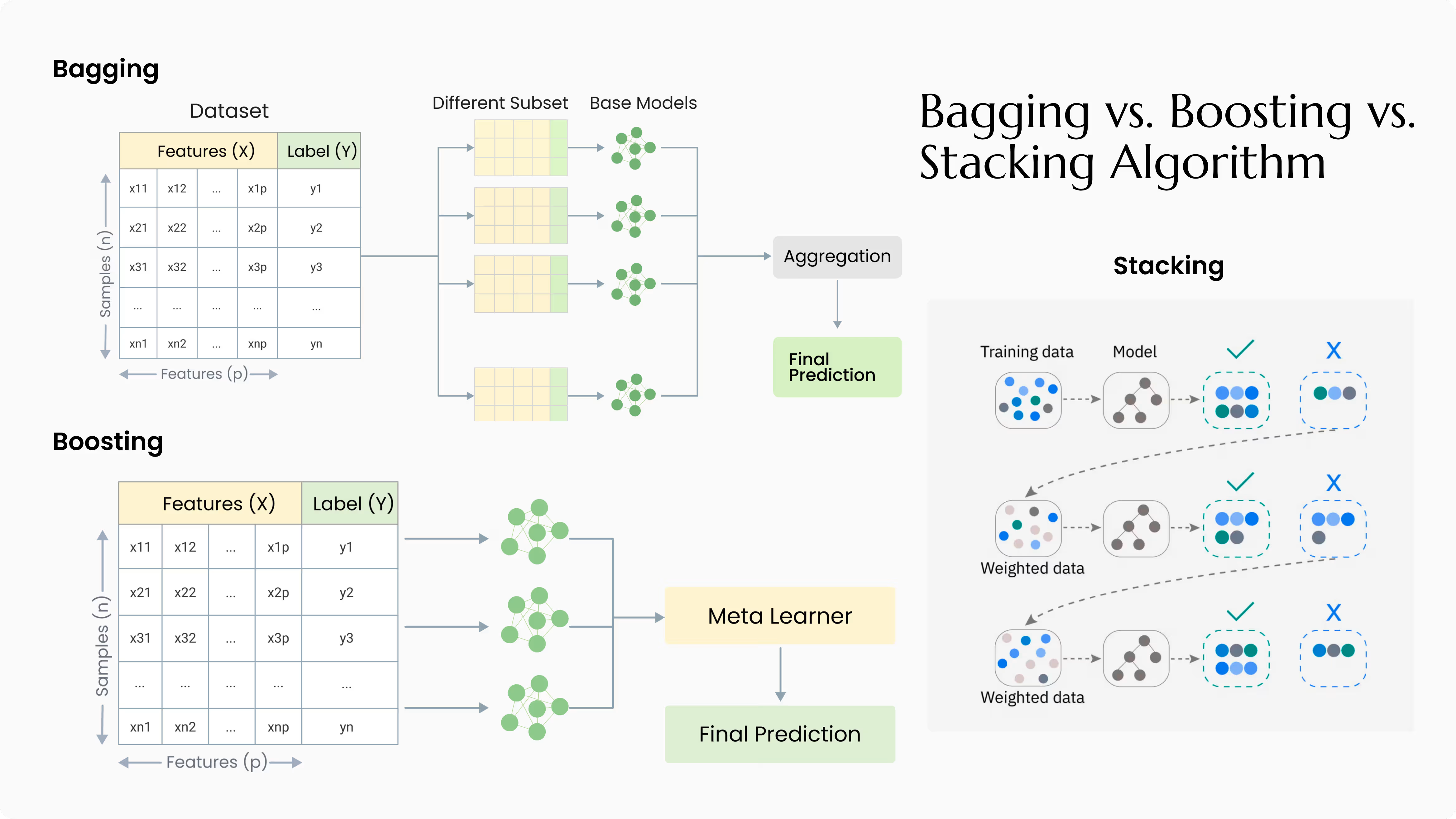
Most of the best-performing models we'll come across in practice aren't single models at all - they're teams of models working together, an idea known as ensemble learning. Instead of betting everything on one algorithm getting it right, we combine several and let their predictions balance each other out. Bagging, boosting, and stacking are the three main ways to build that team, and each does it differently: bagging trains models in parallel to calm down an overfitting model, boosting trains them one after another to fix each other's mistakes, and stacking blends the outputs of different models using another model as the referee. They can look similar from a distance, but mixing them up leads to real problems - tuning the wrong hyperparameters, misreading why a model overfits, or picking the wrong tool for a Kaggle leaderboard versus a production system. Getting the differences straight is what turns "ensemble methods" from a vague buzzword into something we can actually reach for with confidence. Here's the short version before we go deeper.
A single machine learning model can be wrong because of random noise in the data, a limited training set, or a blind spot in the algorithm itself. Ensemble learning fixes this by training multiple models and combining their predictions, so their individual mistakes tend to cancel out - usually producing a result that's more accurate and more stable than any one model alone.
There are three main ways to do this:
- Bagging: train many copies of the same model independently, in parallel, on random samples of the data - then average their predictions. Reduces variance. (Random Forest.)
- Boosting: train models one after another, where each new model corrects the mistakes of the ones before it. Reduces bias. (AdaBoost, XGBoost.)
- Stacking: train several different types of models, then train a small extra model to learn the best way to combine their outputs.
Here's the full comparison, then a fast breakdown of each method below.
Side-by-Side Comparison
| Aspect | Bagging | Boosting | Stacking |
|---|---|---|---|
| Model training | Parallel, independent | Sequential, dependent | Parallel base models + sequential meta-model |
| Primary goal | Reduce variance | Reduce bias | Optimally combine diverse models |
| Base learners | Same algorithm, usually deep/unstable trees | Same algorithm, usually shallow/weak trees | Different algorithms (heterogeneous) |
| Data sampling | Bootstrap sampling (with replacement) | Reweighted / residual-based, full data each round | k-fold cross-validation for meta-features |
| Combination rule | Simple average / majority vote | Weighted vote / additive sum | Learned meta-model |
| Overfitting risk | Low - more trees rarely hurt | Higher - needs careful tuning | Moderate - depends on base model diversity |
| Parallelisable | Fully | Mostly sequential (some row/column subsampling parallelism) | Base models yes, meta-model depends on base outputs |
| Interpretability | Moderate (feature importance available) | Moderate (feature importance, SHAP values common) | Low (multiple models plus a meta-model) |
| Flagship algorithms | Random Forest, Bagged Trees | AdaBoost, Gradient Boosting, XGBoost, LightGBM, CatBoost | StackingClassifier/ Regressor, custom meta-learners |
| Typical training speed | Fast (parallel) | Slower (sequential, though modern libraries are heavily optimised) | Slowest (multiple models + cross-validation) |
Bagging Explained
What is bagging?
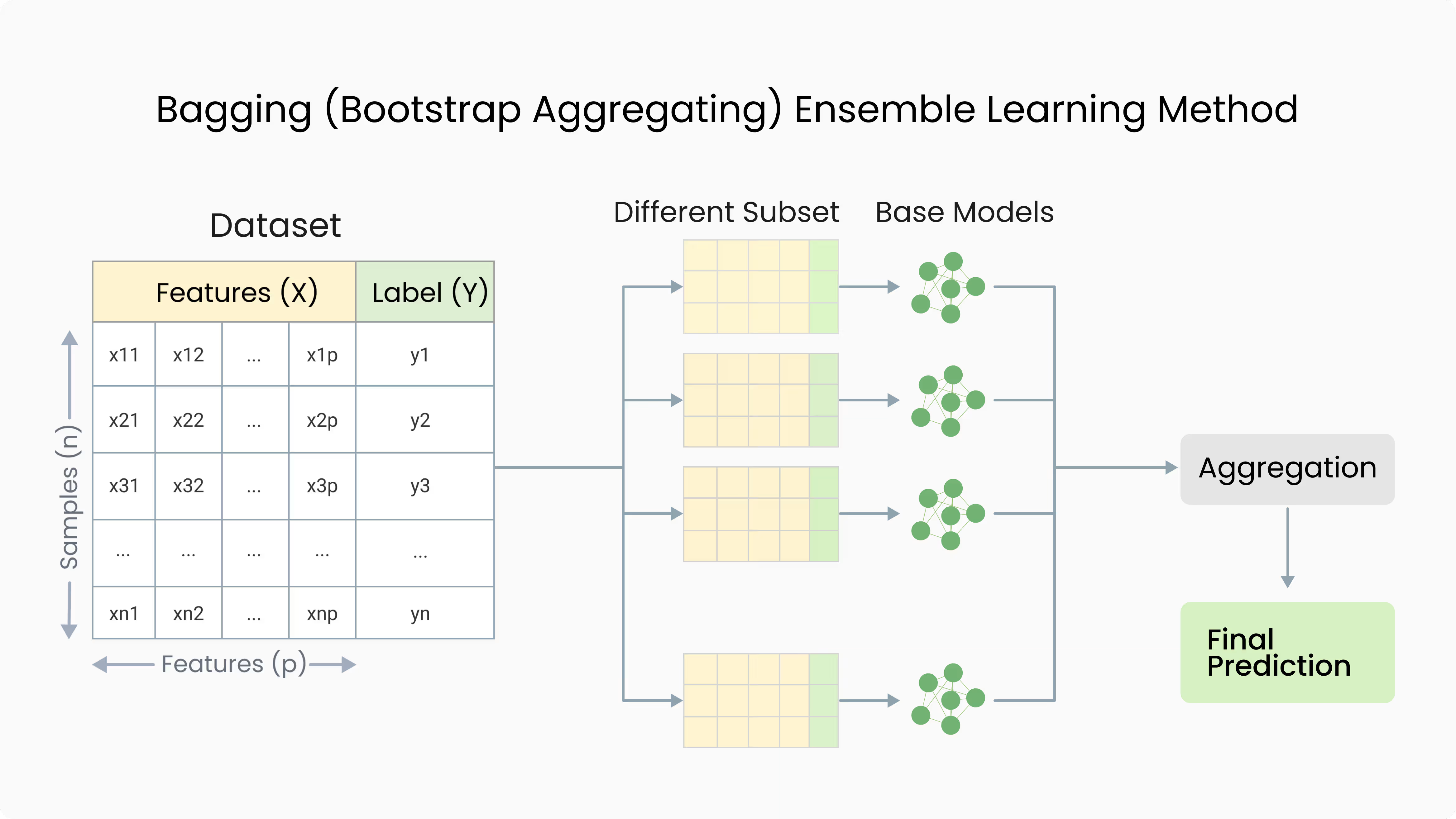
Bagging (Bootstrap Aggregating, Breiman, 1996) trains many copies of the same model independently, each on a different random sample of the training data, then averages their predictions. Random Forest is the best-known example.
How does it work?
- Draw B random samples from the training data with replacement - each sample the same size as the original, but with some rows repeated and others left out. This is called bootstrap sampling.
- Train one model - usually a deep, unpruned decision tree - independently on each sample. All B models can train at the same time, since none depends on the others.
- To predict on new data: average the B outputs (regression) or take a majority vote (classification).
Why does it work?
Deep, unpruned trees tend to overfit. When trained on different bootstrap samples, they make different mistakes. Averaging those predictions cancels much of the random error. In statistical terms, bagging reduces variance (a model's sensitivity to the specific data it was trained on) without needing to fix each model's individual weaknesses. It doesn't help much with a model that's already stable, like linear regression, because there's little random scatter left to cancel.
Example: Random Forest
Random Forest adds one twist: at every split in every tree, only a random subset of features is considered, not all of them. Without this, a single strong predictor would dominate the first split of nearly every tree, making the trees too similar to each other - and similar models make similar mistakes, which defeats the point of averaging. Restricting the features forces more variety between trees, which is why Random Forest usually beats plain bagged trees.
Out-of-Bag (OOB) Validation
Each bootstrap sample only uses about 63.2% of the unique training rows. The leftover ~36.8% - called out-of-bag (OOB) rows - were never seen by that particular model, so they work as a free validation set with no extra split required.
Boosting Explained
What is boosting?
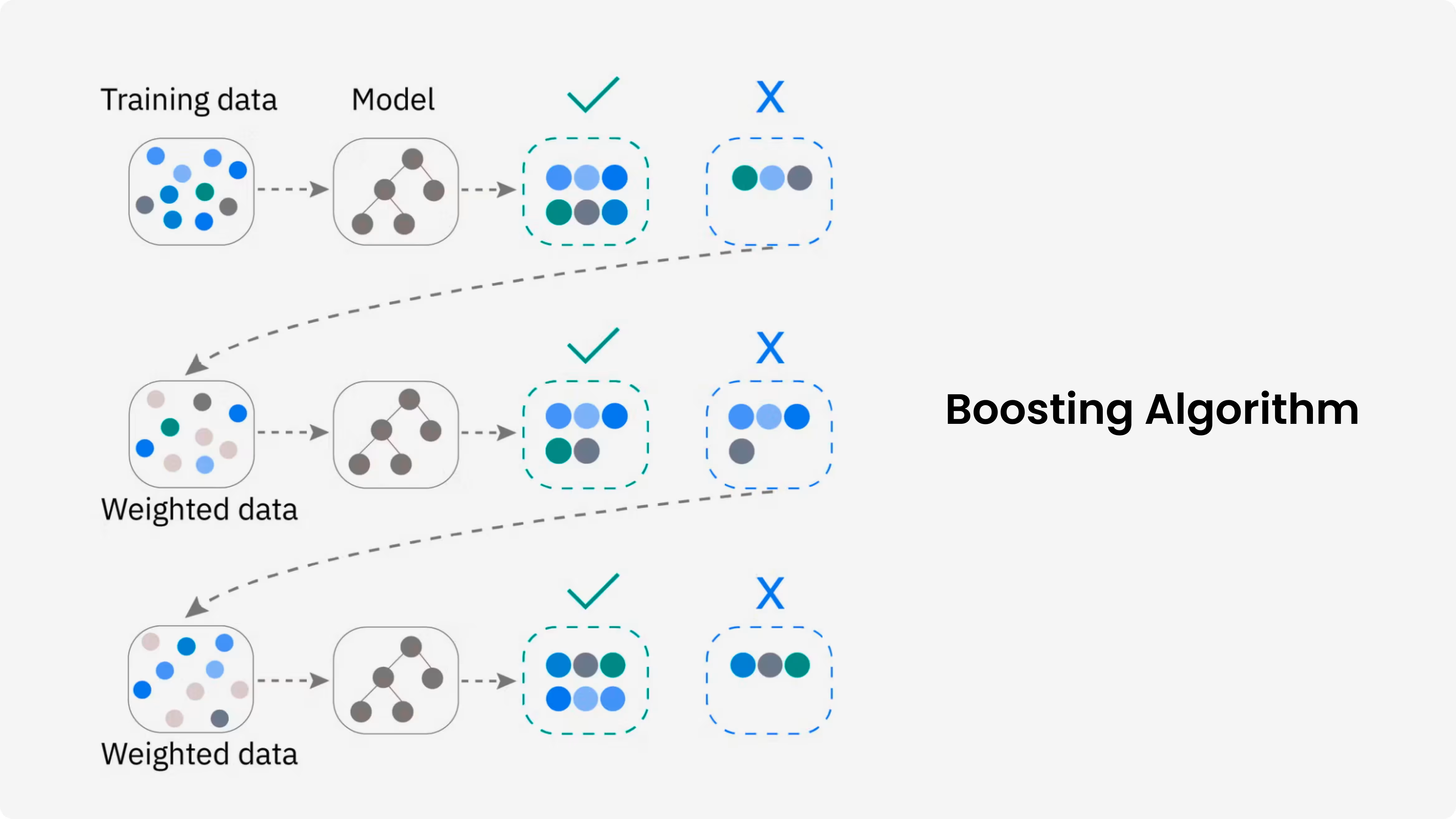
Boosting trains models sequentially: each new model is built specifically to correct the mistakes of the ensemble trained so far. Unlike bagging, the models aren't independent or equally weighted, and training can't be parallelised. AdaBoost and Gradient Boosting (and its modern implementations, XGBoost, LightGBM, CatBoost) are the flagship examples.
How does it work?
- Start with a simple weak learner - a deliberately basic model, like a "decision stump" (a tree with a single split), barely better than random guessing on its own.
- Each new round trains another weak learner whose only job is to fix what the ensemble has gotten wrong so far - AdaBoost does this by increasing the weight on misclassified examples; Gradient Boosting does it by fitting directly to the leftover error (the residual).
- Combine all the learners into a weighted vote (AdaBoost) or an additive sum, scaled by a small learning rate (Gradient Boosting), so no single round overcorrects.
Why does it work?
Weak learners like decision stumps are consistently wrong in predictable ways - high bias, not high variance. Chaining many of them together, each one targeting the previous ensemble's specific mistakes, drives that consistent error down step by step. In statistical terms, boosting reduces bias. Because it's aggressively fitting to the training error round after round, it can eventually start fitting noise instead of signal if left unchecked - which is why learning rate, tree depth, and number of rounds all need careful tuning with early stopping.
Example: Gradient Boosting on House Prices
Start with the simplest guess - the average house price in the dataset. Subtract that guess from each actual price to get the residual (the leftover error). Train a new model to predict those residuals, and add its output on top of the original guess, scaled by the learning rate. The combined prediction is now closer to the truth. Repeat: compute new residuals, train another model on them, add it in - each round shrinks the error a bit more.
"Residual" is the intuitive name; the formal one is gradient - the negative gradient of the loss function. For squared error, the gradient works out to exactly the residual above, which is why gradient boosting is often summarized as "fitting the errors." Framing it as a gradient is what lets the same idea generalize to any differentiable loss function.
Stacking Explained
What is stacking?
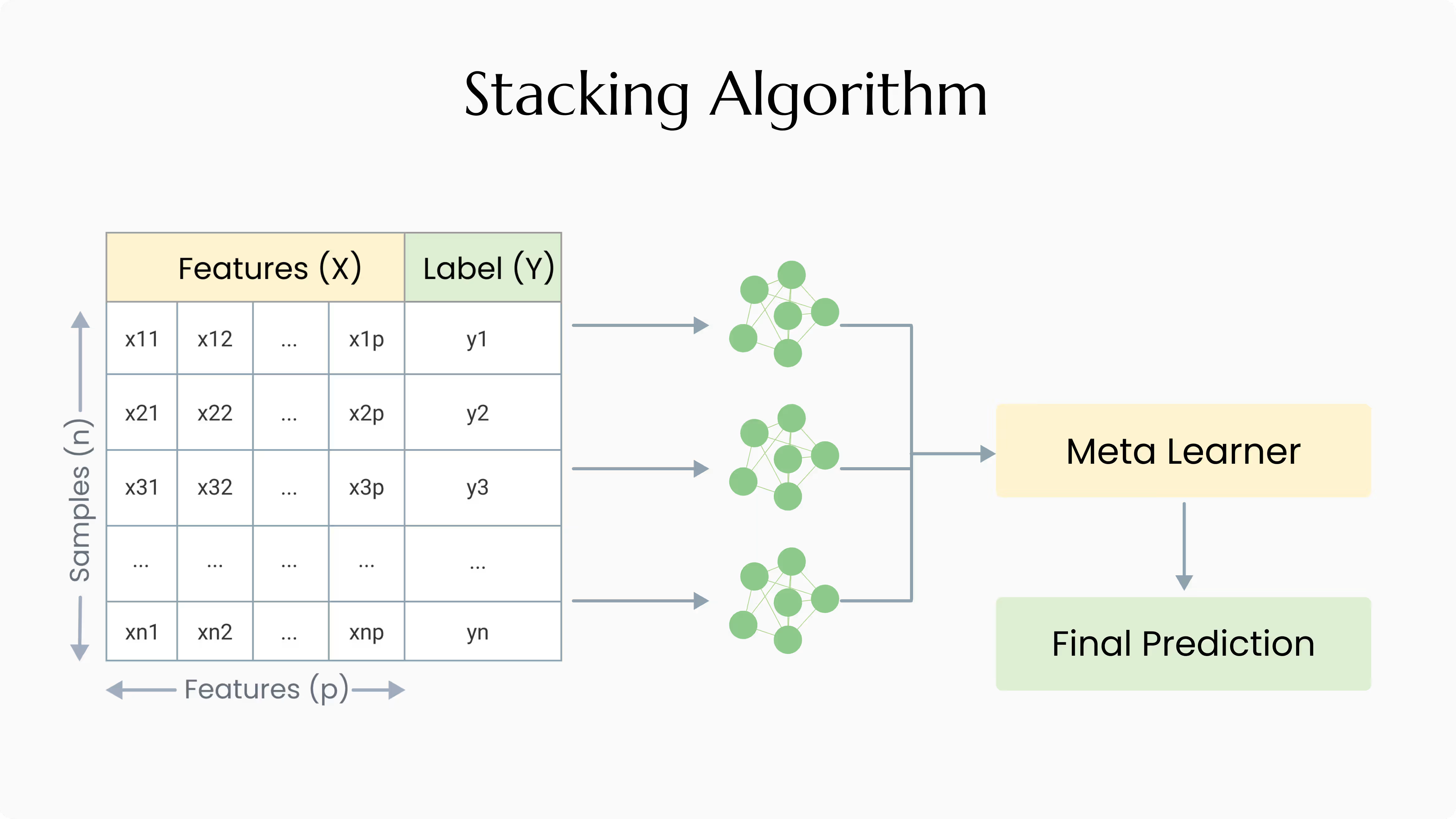
Stacking (Wolpert, 1992) trains several genuinely different types of models - say, a Random Forest, an XGBoost model, and a logistic regression - and then trains one more small model, called a meta-model, whose only job is to learn how to best combine their predictions.
How does it work?
- Choose several diverse base models - diversity of approach matters more than any one model's individual accuracy.
- Use k-fold cross-validation to get honest out-of-fold predictions for every training row: train each base model on k-1 folds, and have it predict only on the fold it never saw, rotating through all folds.
- Train a meta-model - often simple logistic or linear regression - on those out-of-fold predictions to predict the true target. At inference, run new data through all base models first, then feed their outputs into the meta-model.
Why does it work?
Different types of models make different kinds of mistakes - a tree-based model and a linear model tend to err on different examples. The meta-model learns which base model to trust in which situations, extracting a bit of signal none of them capture alone. Out-of-fold predictions matter because training the meta-model on data the base models already memorized would make them look artificially accurate, and the meta-model would over-trust them in a way that fails on new data - like letting a student grade their own exam.
Why Ensemble Learning Works
Combining models only helps when their mistakes are different from each other. If several models tend to be wrong on the same examples, averaging them changes nothing - they all fail together. If their mistakes point in different, unrelated directions, averaging cancels much of that error out. Bagging, boosting, and stacking are three different strategies for engineering that kind of useful disagreement.
A quick way to see this: three forecasters, each right 70% of the time but wrong on different days, will beat 70% accuracy on a majority vote - a vote only fails when at least two of them are wrong on the same day, which is rarer than any one being wrong alone. Three forecasters using the identical flawed method get no such boost.
Bias and Variance, in Full
we've already seen bias and variance in action above - bagging targets variance, boosting targets bias. Here's the fuller picture. A model's error comes from two sources. Bias is error from a model being too simple to capture the real pattern - consistently off in the same direction (underfitting). Variance is error from a model being too sensitive to the specific data it was trained on - swinging wildly depending on which examples it happened to see (overfitting).
Picture five darts thrown at a bullseye. A tight cluster off to one side is high bias - consistent, but consistently wrong. Darts scattered all over the board, even if they average out near the center, is high variance - unpredictable.
Total error is roughly bias plus variance, and the two usually trade off: simplify a model to cut variance and bias tends to rise, and vice versa. Ensembles exist to escape that tradeoff rather than just live with it - bagging averages away variance, boosting chains away bias, and stacking learns to extract whatever signal is left in either direction.
Mathematical Intuition
Two equations capture why bagging and boosting work. Deeper derivations live in the dedicated Random Forest and Gradient Boosting articles.
Bagging: Averaging Reduces Variance
For B independent models, each with variance \(\sigma^2\), the variance of their average is:
$$ \text{Var}\left(\frac{1}{B}\sum_{i=1}^{B} f_i(x)\right) = \frac{\sigma^2}{B} $$
More independent models means a smaller denominator - the scatter shrinks. This is why Random Forest's random feature selection matters mathematically, not just intuitively: it decorrelates the trees, keeping them closer to the "independent" assumption this formula relies on.
Boosting: Additive Correction
Each boosting round adds a correction on top of everything built so far:
$$ F_m(x) = F_{m-1}(x) + \eta \, h_m(x) $$
The new prediction \(F_m(x)\) is the old prediction \(F_{m-1}(x)\) plus a new weak learner \(h_m(x)\), trained to predict the negative gradient (the residual, for squared error), scaled down by the learning rate \(\eta\) so no single round overcorrects.
Advantages & Disadvantages
| Method | Advantages | Disadvantages |
|---|---|---|
| Bagging | Robust to overfitting; trains in parallel; free OOB validation; little tuning needed | Can't reduce bias; usually lower peak accuracy than tuned boosting; larger memory footprint |
| Boosting | Usually highest accuracy on tabular data; flexible loss functions; fast, production-proven implementations | Prone to overfitting without careful tuning; sequential training limits parallelism; sensitive to noise and outliers |
| Stacking | Can beat any individual base model; works with any model combination; standard for competition-level gains | Most complex and expensive of the three; higher overfitting risk if base models lack diversity; hardest to interpret and maintain |
When to Use Each Method
The tradeoffs above translate directly into a decision:
Use bagging (Random Forest) when: we want a strong, low-maintenance baseline with minimal tuning; wer base model clearly overfits and has high variance; we need built-in feature importance and reasonable interpretability; training speed matters and we can parallelise; the data is noisy and robustness matters more than the last percent of accuracy.
Use boosting (XGBoost/LightGBM/CatBoost) when: maximum predictive accuracy on tabular data is the priority; we have time to tune hyperparameters and validate properly; the data is reasonably clean; we need flexible objectives - ranking, quantile regression, custom loss functions. This is the default choice for tabular competitions and most production risk/fraud/recommendation systems.
Use stacking when: we already have several strong, diverse models and want a final accuracy boost; the marginal gain justifies added complexity and latency; we're optimising for a leaderboard where every fraction of a percent counts.
Real-World Applications
Bagging / Random Forest: credit risk scoring, where regulators value stable, explainable feature importance.
Boosting / XGBoost / LightGBM: fraud detection and ad/search ranking - and the large majority of winning solutions in tabular Kaggle competitions.
Stacking: competition leaderboards, where blending diverse model families (trees, linear models, neural nets) squeezes out a final gain.
Common Interview Questions
These are the "why," not "what" questions interviewers actually probe once they know we've memorised the definitions.
Q: Why does bagging reduce variance but not bias?
Averaging unbiased estimators leaves the expected value - and therefore bias - unchanged, while variance shrinks as more estimators are combined: Var(average) = σ²/B for B independent models. Bagged models are trained on correlated bootstrap samples rather than fully independent data, so the reduction is real but bounded by that correlation.
Q: Why does boosting risk overfitting more than bagging?
Bagging averages independently-trained models, so adding more of them can't make the ensemble fit training noise any more precisely. Boosting explicitly reduces training error round by round, which - left unchecked - eventually fits noise rather than signal. That's why learning rate, depth, and early stopping are essential boosting hyperparameters with no direct analogue in bagging.
Q: What is the difference between AdaBoost and Gradient Boosting?
AdaBoost reweights misclassified examples and combines weak learners via a weighted vote, working natively with exponential loss. Gradient Boosting generalises this to any differentiable loss by fitting each learner to the negative gradient - AdaBoost is, in fact, a special case of gradient boosting under exponential loss.
Q: Why must stacking use out-of-fold predictions for the meta-model?
Predicting on data the base models were trained on would give artificially accurate inputs, since those models have already memorised that data - the meta-model would learn to over-trust them. Out-of-fold, cross-validated predictions simulate genuine held-out performance instead.
More ensemble and ML theory questions - with full answers - are in our ML Interview Guide.
Key Takeaways
- Bagging trains models independently and in parallel on bootstrap samples, then averages - it primarily reduces variance. Random Forest is bagging plus random feature selection at each split.
- Boosting trains models sequentially, each correcting the previous ensemble's errors - it primarily reduces bias. AdaBoost reweights examples; Gradient Boosting (and XGBoost, LightGBM, CatBoost) fits residuals via gradient descent in function space.
- Stacking combines diverse, heterogeneous models using a learned meta-model trained on out-of-fold predictions - it extracts complementary signal that no single model captures alone.
- All three exploit the same underlying statistical principle: combining models with different, ideally uncorrelated errors produces a more accurate result than any individual model.
- For most tabular problems: start with Random Forest as a robust baseline, move to tuned XGBoost/LightGBM for maximum accuracy, and reach for stacking only when we need the final increment of performance and can absorb the added complexity.
Frequently Asked Questions
- Bagging trains many models independently and in parallel on bootstrap samples of the data, then averages their predictions to reduce variance. Boosting trains models sequentially, where each new model focuses on correcting the errors of the ones before it, primarily reducing bias. Bagging models are equally weighted; boosting models are weighted by their accuracy and built to explicitly compensate for prior mistakes.
- Random Forest is a bagging method. It builds many decision trees independently and in parallel, each on a bootstrap sample of the training data, and adds an extra layer of randomness by selecting a random subset of features at every split. The final prediction is the average (regression) or majority vote (classification) across all trees.
- XGBoost is a boosting method - specifically, an optimised implementation of gradient boosting. It builds trees sequentially, where each tree is trained to predict the residual errors of the combined ensemble so far, and it adds regularisation, second-order gradient information, and engineering optimisations on top of standard gradient boosting.
- None is universally better - each addresses a different problem. Bagging is the safest choice when wer base model overfits and we want a robust, low-maintenance baseline (Random Forest). Boosting is the best choice when we need maximum predictive accuracy on structured/tabular data and can afford careful tuning (XGBoost, LightGBM, CatBoost). Stacking is best when we already have several diverse, reasonably strong models and want to extract a further, usually small, accuracy gain by combining them intelligently.
- Bagging primarily reduces variance. Averaging many high-variance, low-bias models (like deep, unpruned decision trees) smooths out their individual noise while leaving the average bias roughly unchanged. This is why bagging is most effective with unstable, overfitting-prone base learners rather than already-stable, high-bias ones.
- Boosting primarily reduces bias. It starts from simple, high-bias, low-variance base learners (shallow trees, sometimes called decision stumps) and sequentially adds models that correct the ensemble's residual errors, driving down training error step by step. Because this process can eventually overfit if left unchecked, boosting implementations rely heavily on regularisation - learning rate shrinkage, tree depth limits, and early stopping - to control variance.
- Yes. Some ensemble strategies combine both ideas - for example, training a boosted ensemble on bootstrap samples (stochastic gradient boosting, which XGBoost and LightGBM support via row and column subsampling), or bagging a set of boosted models to further reduce variance. These hybrid approaches are less common than plain bagging or boosting but appear in some Kaggle-winning solutions and production systems that need both robustness and accuracy.
- Stacking and blending both combine predictions from multiple base models using a meta-model, but they differ in how out-of-fold predictions are generated. Stacking uses k-fold cross-validation to produce out-of-fold predictions for every training row, which the meta-model then learns from - this uses the full training set but is more expensive. Blending instead holds out a single validation set to generate meta-features, which is faster and simpler but uses less data and is more prone to overfitting the holdout split.
- Bootstrap sampling draws N rows with replacement from a training set of size N, so each sample is a different but statistically similar version of the original data. On average, about 63.2% of unique rows appear in each sample, leaving ~36.8% as out-of-bag (OOB) rows. Averaging models trained on different bootstrap samples reduces variance, because the sampling noise in each sample is at least partly independent.
- No. Random Forest, AdaBoost, Gradient Boosting, and XGBoost are tree-based, and trees split on threshold comparisons rather than distances, so they are invariant to monotonic feature transformations. Scaling is unnecessary here, unlike for distance-based models (k-NN, SVM) or gradient-descent-based linear models.
- For bagging methods like Random Forest, more trees almost never hurt accuracy - they only cost more compute - so a common approach is to increase n_estimators until performance plateaus on a validation set, then stop for efficiency. For boosting methods, more rounds eventually cause overfitting, so the number of estimators should be tuned together with the learning rate and controlled with early stopping on a held-out validation set, since a lower learning rate generally needs more rounds to converge to comparable performance.